




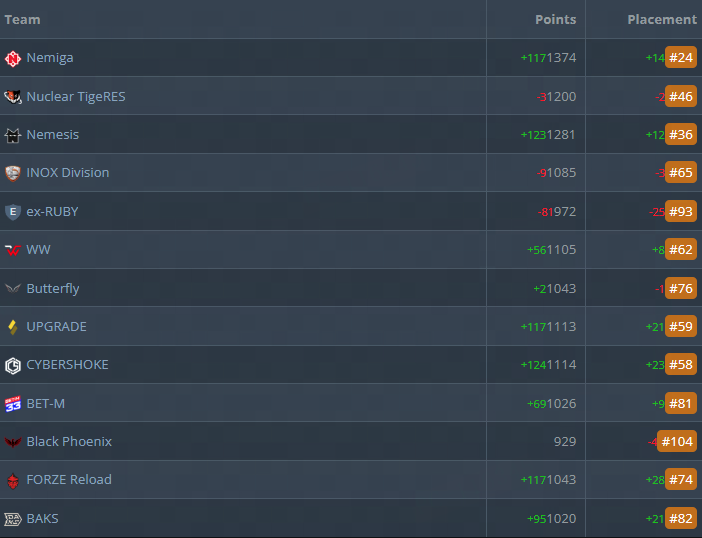
A tournament called WINLINE MPKBK CIS LAN Season 7 has concluded, with most participating teams accumulating considerable points. Among these teams, apart from three that did not complete all five matches (teams that did not play the full five matches do not have their points and rankings displayed), there is also one particularly "unlucky" team that lost a significant amount of points, while almost all other teams gained points. Visually, the overall point changes show more points gained than lost, with 820 points "appearing out of thin air," while only 93 points were lost. So, how are the points calculated? Why did so many points suddenly appear?
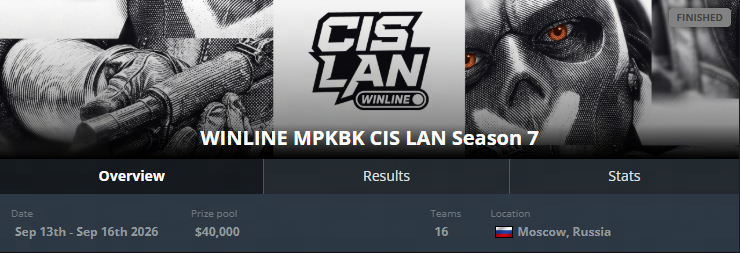
Let's start with the match itself. 16 teams compete for $40,000 in a double-elimination BO3 format, with single-elimination BO3 in the playoffs and BO5 for the finals. Most importantly, it's an offline event, with participating teams ranging from over 40 to over 100 players. Some teams that didn't complete all five matches have no rankings. (Winning against these unranked teams won't add points, and losing to them won't deduct points either.)
Valve's VRS (Valve Rating System) roughly consists of five components: BCOL ("Bounty" obtained by defeating opponents), BOFF (bonus-related performance factor in tournaments), NETW (opponent network strength), LANW (LAN match wins), and H2H (head-to-head match intensity). Based on these factors, the points earned differ between defeating a strong team versus a weak team, between online and offline matches, and across different tournaments (varying in tier, such as comparing the Cologne Major to the India Sky Cup).
So why does this match yield so many points? Factoring in these mechanisms, it’s an offline tournament. For teams that haven’t participated in offline events regularly, this match is particularly attractive—a revenue opportunity not to be missed. Offline tournaments have a cap on the number of wins and points. While the prize money is lower, it doesn’t mean the points are fewer. The point weight of the tournament only affects the value of the results in VRS.
Rankings affect point changes, such as when a weak team defeats a strong one to earn points, as seen in this match:
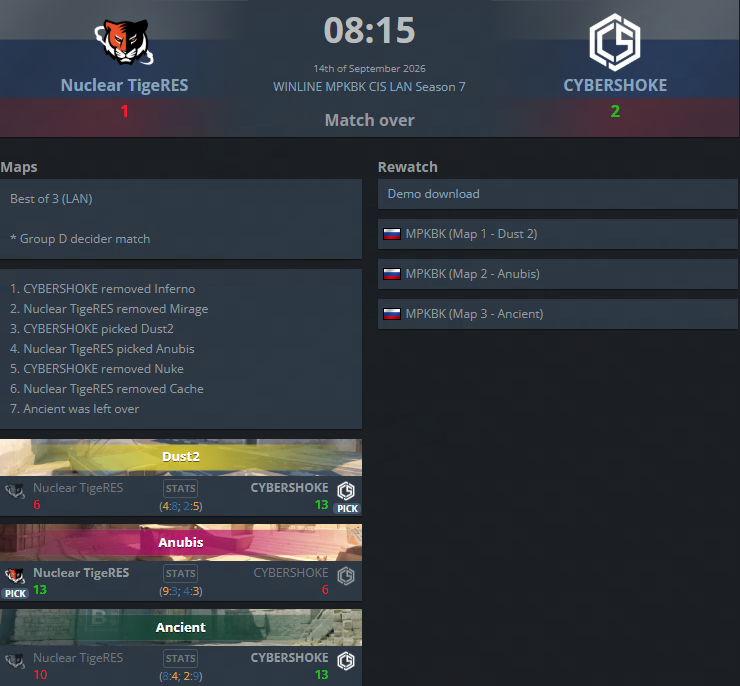
Pre-tournament ranked 44, Nculear Tiger was defeated by CYBERSHOKE, who was ranked 81 pre-tournament. The winner gained 59 points, while the loser only dropped 19 points, effectively adding 40 points "out of thin air." These 40 points were not deducted from Nculear Tiger and given to CYBERSHOKE, but rather recalculated based on the team's recent performance, opponent quality, prize money, offline wins, and other metrics to determine "how many points the team is worth." The relationship between "points lost in a defeat" and "points gained in a win" is not symmetric.

Then why not simply add or subtract points as needed? VRS takes into account the value of the opponent itself—the higher the rank and better the network of the team you defeat, the more points you earn. Although here it is a LAN event unaffected by network conditions, it still benefits from the LAN bonus.
Time also affects VRS, as points have a "time-sensitive" quality. Participating in an offline tournament now does more than just add a recent result; it also refreshes the recent VRS data structure, and points gradually decay over time. Offline wins also refresh rather than being permanently saved—winning a new offline match contributes a highly valuable LANW (Offline Win Contribution), which is why the teams seen in this match, despite defeating a lesser-known niche team, can still earn a significant number of points. If a team's old LANW value decays while a new LANW is particularly valuable and recent results are factored into VRS, it becomes easier to gain a large number of points from a single match.

The reason for the low points in this tournament isn't just because the prize pool is only 40,000; rather, it's the combination of a 40,000 prize pool, the presence of numerous second-tier teams, and multiple BO3 matches—which makes it ideal for second-tier teams to accumulate points. Additionally, VRS points are not conserved; they are not distributed arbitrarily but are generated based on new performance data from the matches, with more points being added than deducted.
So why are LAN tournaments particularly important? The LAN win step is calculated separately, and the top ten results from the past six months are considered only for prize money/opponent network/LAN tournament wins. Thus, a single victory can generate multiple valuable VRS factors, and the value of the VRS may also be much higher than intuitively imagined by just looking at the prize amount.

Then, what about the decay of integrals?
These points decay gradually over time, rather than automatically resetting to zero on a specific day or following a fixed linear reduction. Each match carries a time-varying weight that is automatically applied to its original contribution. The acquired points are like a slowly melting block of ice: the old ones shrink gradually, and if the new points are substantial enough, they can replace the old ones. Therefore, professional teams aiming to participate in Majors must consistently compete in high-value events.

So this explains why FaZe, the runner-up from the previous Budapest Major—who had accumulated significant points from the first stage to the finals in Budapest—would still frantically register and participate in obscure side tournaments as the Cologne Major approached, even competing against American collegiate teams. Some uninformed fans might have thought at the time, "If they can't win, they shouldn't compete—they'd at least avoid losing!"

So why did FaZe "grow more resilient with each setback," persistently trying even when their form was poor? It was precisely because FaZe kept losing at the time, not only losing points but also having their older points decay as Cologne approached. They had no choice but to earn some new points to secure their spot, only to ultimately be crushed by DaZhuang's iron fist—the last straw that broke the camel's back, costing them their Cologne Major qualification.

I am sorry I failed to fully satisfy Master Dazhuang...
And according to the simulations by the Major probability author, zewih's former team Nemiga has seen a dramatic surge in points due to their recent offline tournament performance. It’s as if other teams are still scraping by with basic strategies, while Nemiga has feasted on the core rewards of the tournament and made a clean getaway. The simulation author noted that Nemiga "has been elevated from the 'other teams' category. I expect their payment from CIS LAN 8 will come through. But this wave of results is truly impressive, a wild explosion."

As can also be seen from this chart, Navi, who has been in poor form lately, has not only suffered frequent defeats and lost points, but also faces a critical situation because their points from previous events are slowly expiring. The entire team is on the brink; heading into the first stage, if they are quickly eliminated in upcoming matches, they might even lose their qualification. FaZe isn't faring much better—they're completely scrambled. Author's note: "FaZe missed Thunderpick by a single point and also gave up Season 5 of Stake. All they truly need are LAN wins—just competing in any high-school-level offline event would fill their quota. If they perform poorly at Stake 4, things could start looking really dangerous."

This explains why BCGAME is frantically trying to participate in an $80,000 offline tournament, competing fiercely to get into the qualifiers. Since the formation of BCG's new roster, they have finally managed to win a qualifier, securing the opportunity to compete in Stake Pulse Beat III (with an $80,000 prize pool). It's all about the points. BCG is a gambling website with abundant resources; $80,000 is trivial compared to the two million-plus spent on signing three Portuguese players. Moreover, these niche tournaments are already obscure, and the closed qualifiers add another layer of obscurity. Therefore, the qualifiers are not recorded by HLTV, meaning that even losing to teams ranked over 300th will not result in a loss of ranking points. As the saying goes, "A stone at the bottom has nowhere to fall"—winning adds points, and losing doesn’t cost much. With this opportunity, why not give it a try?

In the end, just one day before the Major invitation deadline, a niche yet explosive esports event emerged: XPL Luoyang, a $50,000 offline tournament attracting European traffic teams like 100T and BCG. With just these two teams alone, this niche offline event boasted a combined total of 16 Major championships and 5 Major MVPs (counting repeats). Holding the offline tournament the day before the Major invitation, it was a last-minute preparation, minimizing point decay while maximizing the accumulation of points. The offline, double-elimination, BO3 format, combined with relatively weaker participating teams, allowed the winner to farm points to the fullest right before the Major.

And due to the minimal prize pool, long distances, and the absence of proper training facilities—only a small warm-up room—the entry barrier is quite high. Many teams weigh whether the cost of participating without guaranteed wins would result in "pure financial loss," which discourages those aiming for points farming. BCG and 100T, of course, are not short on funds, so they will naturally join this tournament. For domestic fans, it is also a positive opportunity to see SSEN and Lao Ba compete on home soil.