




Recently, an older interview with Gabe Newell discussing Valve's corporate structure has regained attention. In the interview, Gabe explains why Valve has always maintained its private status and shares some of the company's core principles regarding talent, decision-making, and organizational structure.
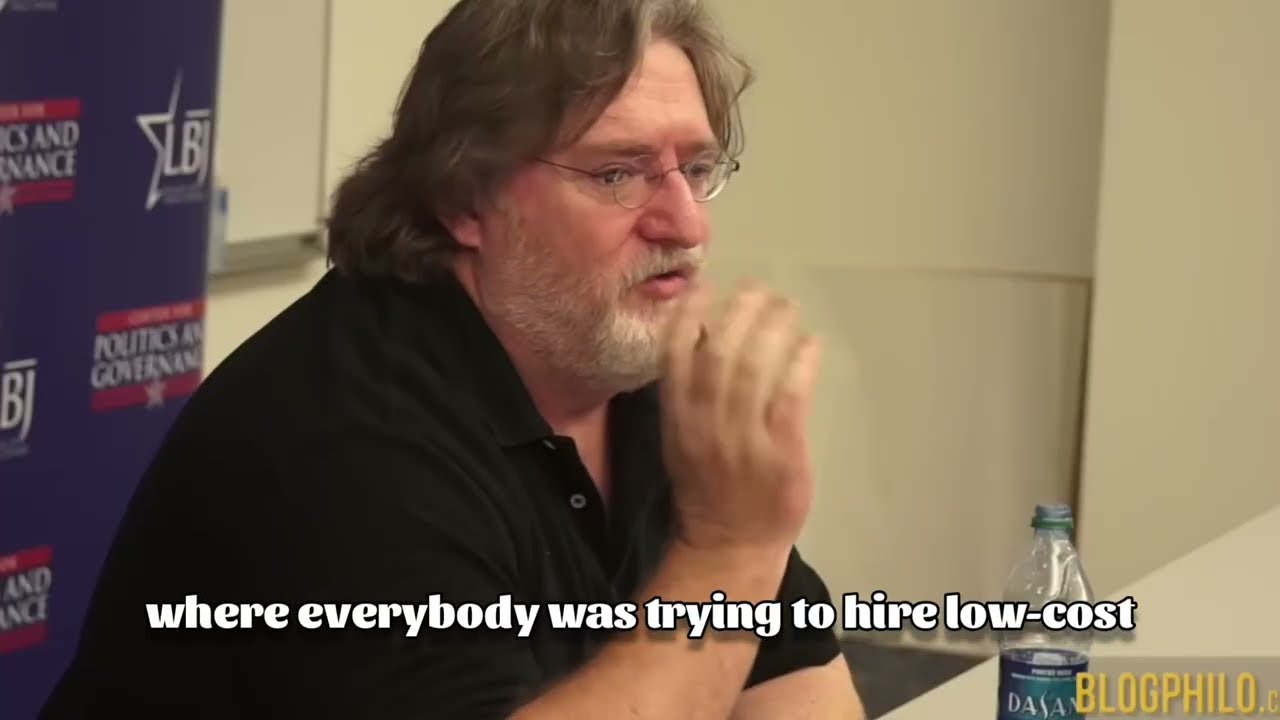
Gabe: When we were designing Valve, we always revolved around one fundamental question: how to attract and keep the most productive people in the world?
Because if our judgment is correct, then these talents are where we create the greatest incremental value.
A few years ago, many companies were trying to find lower-cost content producers from places like India, while what we did was exactly the contrary.
The idea is, if someone makes $200k a year making movies in New Zealand, then if they come to Valve, they should be able to make $500k—even $5 million—assuming they’re actually generating that much value.
Certainly, these choices will also bring some consequences.
One of which is that Valve is not a publicly traded company.
Becoming a public company brings a whole bunch of headaches and actually doesn't help us solve any problems.
This means that third parties will start to get involved in decision-making power and control.
For developers at Valve, or anyone working on a product, you are facing users, and they are the ones you truly want to satisfy.
Starting from the moment you make a single modification to the product, in the worst-case scenario, users will have access to this version within about 15 minutes.
There is no approval process here.
If you made a wrong decision, you can fix the issue 15 minutes later.
You don't need to rush to attend a board of directors meeting just to have the board discuss what investors are worried about, how to handle equity dilution, or whether certain targets must be met.
nor will any distribution channel come up to us and say: 'We currently need a product and it must be forced into that specific slot at that particular moment.'"
The significance of maintaining a private company lies in reducing another layer of "noise" between consumers and product producers.
Furthermore, we believe that those truly suited to this model do not actually require any job titles.
In fact, the title might actually become their enemy rather than something that makes them more productive.
The methods for solving problems in this generation are often completely different from the previous generation. If you rigidly fix the organizational structure based on job titles, it may actually reduce the likelihood of generating new ideas and creating truly interesting innovations for the next generation.
Half-Life 1 is a great example. The person who designed the skeletal animation system at the time also held a bachelor's degree in art and was capable of creating environment art.
So some of the experiences you see in the original Half-Life are simply because the people responsible for solving problems could modify the environment, the code, or the animations based on the actual situation, choosing the easiest way to solve the problem.
And job titles within an organization often prevent people from truly thinking around a problem itself and solving it in the most efficient way.